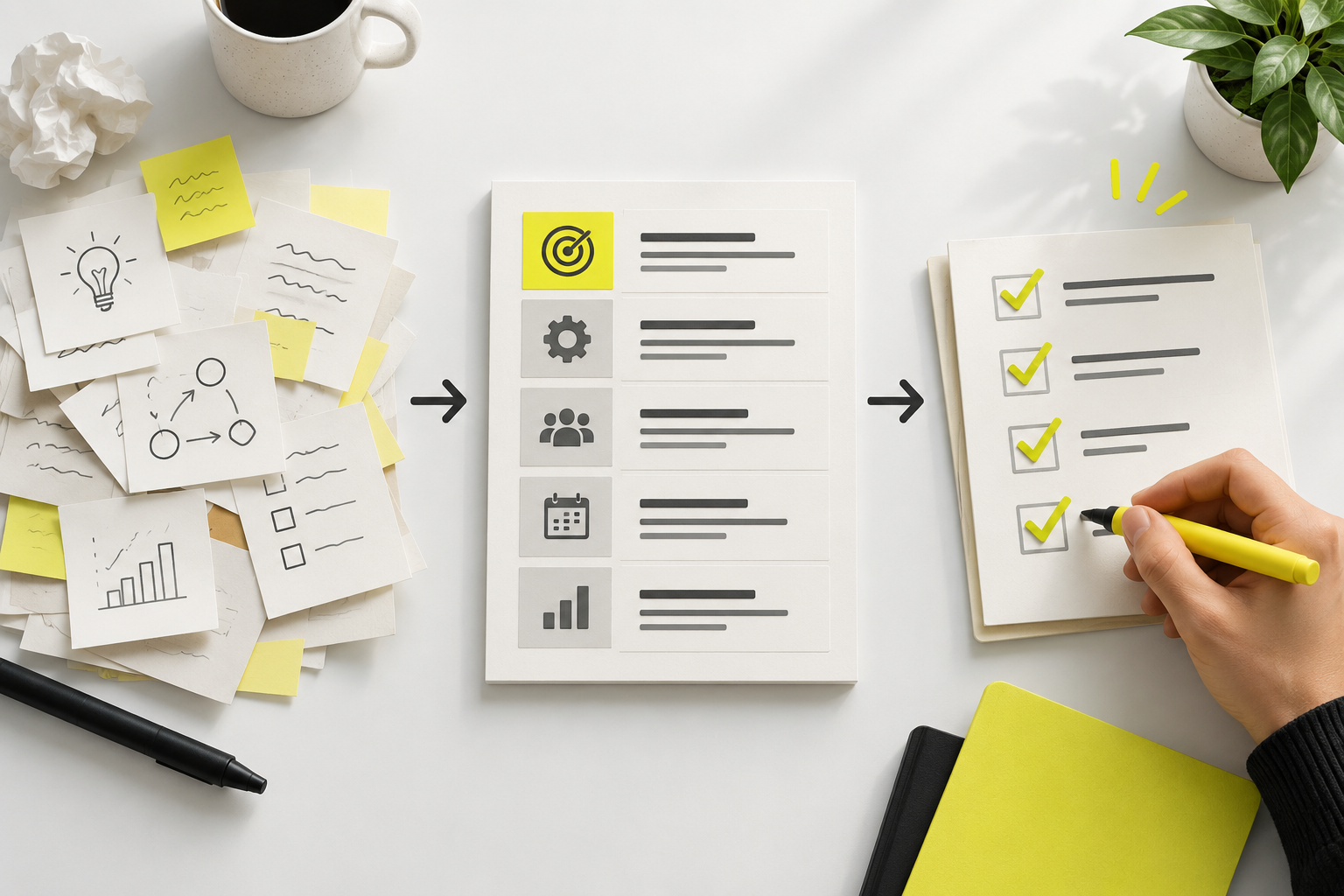
Find courses that describe risk analysis or scenario work. A useful exercise should make assumptions visible and help you challenge a proposed risk response.
Choose a repeatable exercise
Use a risk register; check evidence, likelihood, impact and proposed responses before sharing it.
This is an editorial practice suggestion, not a claim that every listed course includes this exercise. Check each provider’s advertised curriculum.
46 PM-specific routes and 8 broader workflow routes mention this task. Labels below keep the two collections separate.
Day one covers lifecycle use cases, scope/schedule/WBS support, resource/cost/scenario analysis and risk identification/mitigation. Day two covers progress analysis and early-warning indicators, executive dashboards/status narratives, stakeholder/meeting workflows, governance, confidentiality and an implementation plan.
The reference syllabus covers AI PM tools and governance, PM-specific prompting, business cases and charters, WBS/schedule/resources, risk scoring and Monte Carlo scenarios, Agile work, communications/reporting, monitoring/change control, cost forecasting, PMO tools, responsible use, lessons learned and scaling.
AI support for Scrum Master work across meetings, team communication, backlogs, timeline/risk analysis and team performance insights; provider page describes templates/tactics and a final realistic role simulation.
Uses ChatGPT and Gemini to produce a project-document toolkit from a realistic scenario: initiation/charter, scope and schedule, cost and resource plans, risk register, stakeholder work, execution and earned-value monitoring, issue/performance reporting, closeout and post-project evaluation. Includes privacy and responsible-use guidance.
prompts for charters/scope/WBS, activities/dependencies and three-point estimates
risk triggers and early warnings
status/meeting automation
capacity planning
privacy and human-review checkpoints. Day-five labs build a charter/WBS/estimate, risk register/early-warning report, tested prompt library, team AI policy and a PM playbook.
Use a realistic AI/hybrid project case to plan, identify, analyze, respond to and monitor project risks; build a risk breakdown structure and register, apply qualitative scoring and Expected Monetary Value/decision trees, and define response, fallback and dashboard indicators.
Seven modules cover AI tools for PM, data-driven project decisions, collaboration/productivity, ethics and bias, project-data preparation, implementation and monitoring, risk management and future PM use cases.
Topics cover the project life cycle, logical framework, AI forecasting and scenario planning, Gantt/PERT estimates, monitoring and evaluation, risk prioritization, data quality, automation, dashboards, reporting, governance, ethics and data security.
benefits and executive reporting. Methods include ISO31000 risk registers, DORA indicators, conceptual Monte Carlo/anomaly detection, human-reviewed AI estimates and NIST AI RMF review gates.
Covers AI-supported initiation, charters, scope, WBS/backlogs, estimation, scheduling and scenarios, RAID/risk management, capacity, stakeholder reporting, privacy and governance; ends with an implementation lab and capstone on configuring PM tools and measuring a pilot.
The five-day outline moves from AI/data and PM tool analysis to an AI-driven schedule scenario and resource-allocation model, predictive risk assessment/monitoring, responsible integration and team change, then a practical AI-PM tool exercise and personal implementation action plan.
The current program identifies BAI 204, prerequisite BAI 201, as a compulsory three-credit course. The official 2025-26 catalogue says learners study AI opportunity identification, project feasibility, AI-project risk, data preparation, model development, AI ethics/governance and deployment strategies, with real-world AI implementation cases.